Is Your Tarmac Driveway Suitable for Resurfacing?
A worn tarmac driveway does not always need to be removed and completely rebuilt. When the underlying construction remains stable, resurfacing can renew the visible layer and restore a smooth, consistent finish. However, laying fresh tarmac over a failing base will not correct deeper structural problems.
The suitability of a driveway for resurfacing therefore depends on what is causing its deterioration. A professional assessment can establish whether the damage is confined to the surface or extends into the foundation beneath it.
How to Determine Whether Tarmac Resurfacing Is Suitable
Resurfacing generally involves preparing the existing driveway and applying a new surface course. For this approach to succeed, the remaining structure must be capable of supporting the new material without excessive movement.
The Existing Base Must Be Stable
A durable tarmac driveway relies on a well-prepared and properly compacted sub-base. If this foundation remains firm, the existing surface can often provide suitable support for a new layer.
Signs of possible base failure include deep depressions, widespread movement, repeated potholes and cracks that return after previous repairs. Resurfacing over these defects may temporarily improve the appearance, but the underlying movement is likely to affect the new surface.
Surface Wear Can Often Be Resolved
Resurfacing may be appropriate when deterioration is largely limited to the upper layer. Typical examples include:
- General fading and loss of surface texture
- Shallow cracks in isolated areas
- Minor fretting or loose surface material
- Previous repairs that have created a patchwork appearance
- Light wear caused by regular vehicle use
- Small areas of surface damage that can be prepared first
The damaged sections must still be repaired correctly before the new tarmac is installed. Covering loose or unstable material without preparation can weaken the finished surface.
Extensive Cracking Requires Investigation
Not every crack means that a driveway needs complete replacement. Fine, localised cracking may result from ordinary ageing and can sometimes be treated during preparation.
Widespread, connected or deep cracks require closer attention. They may indicate movement beneath the tarmac, insufficient support or water entering the construction. Unless the cause is corrected, these cracks can eventually reflect through a new surface layer.
Potholes May Reveal Deeper Damage
A small pothole caused by localised surface failure can often be cut out and repaired before resurfacing. Several potholes, particularly those that keep returning, may suggest that water and vehicle pressure have weakened the underlying layers.
The affected areas should be opened and examined so that unsuitable material can be removed and reconstructed. If deterioration extends across most of the driveway, more comprehensive replacement may provide a stronger result.
Drainage Must Work Properly
Standing water can penetrate cracks and accelerate the breakdown of tarmac. It may also indicate that the driveway has settled or was not formed with effective falls.
Before resurfacing, the route taken by rainwater should be assessed. Minor level adjustments may sometimes be incorporated into the work, but substantial drainage or gradient problems could require parts of the driveway to be reconstructed.
A new surface should direct water effectively rather than simply conceal low spots.
Existing Levels Need to Allow for a New Layer
Adding another layer of tarmac raises the finished surface. This must be considered around entrances, garage thresholds, gates, drainage channels and adjoining paths.
There should be enough room to install the new material at the correct depth while maintaining practical transitions. In some cases, the existing surface may need to be reduced or removed around boundaries to achieve secure edges and suitable levels.
Strong Edges Are Essential
The edges of a driveway help contain the tarmac and protect it from lateral movement. Broken, unsupported or crumbling margins can cause the new surface to deteriorate prematurely.
Any damaged edging should be corrected as part of the preparation. A secure perimeter helps the resurfaced driveway retain its shape under regular vehicle use.
When Is Full Replacement More Appropriate?
Complete replacement may be the better option when the driveway has widespread structural failure rather than surface wear. Indicators can include:
- Extensive sinking or severe unevenness
- Movement across large sections
- Persistent drainage problems
- Numerous deep cracks and potholes
- Weak or unsuitable foundation material
- Repeated failure of earlier repairs
- Levels that cannot accommodate resurfacing
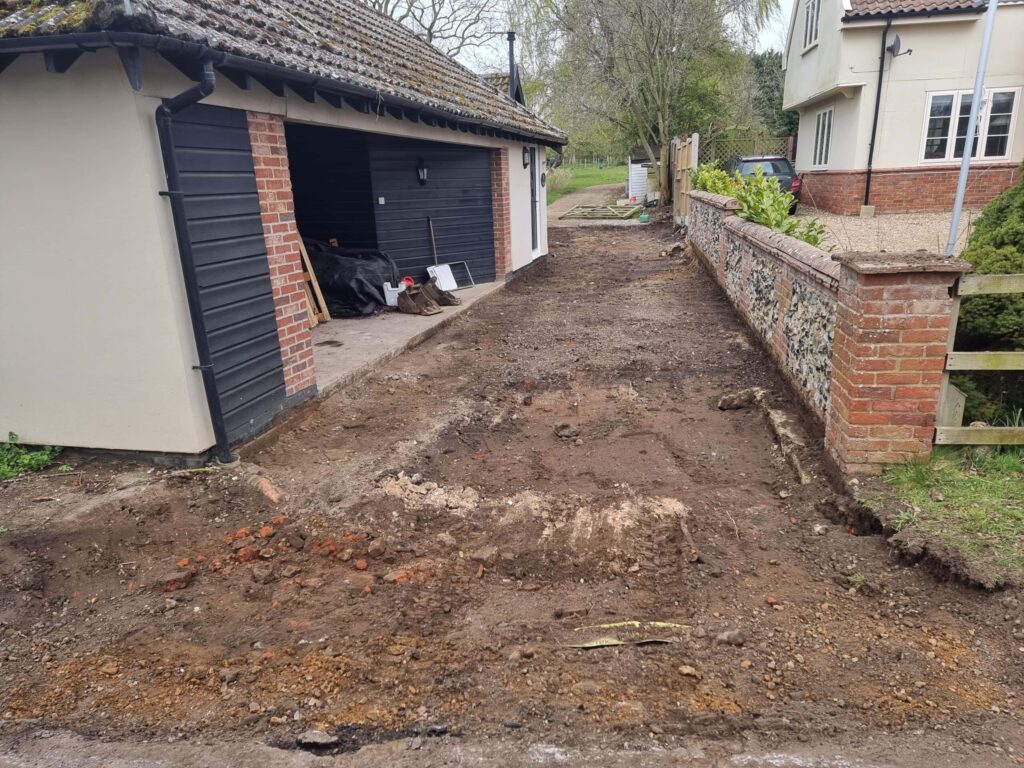
Removing the existing driveway provides access to the underlying ground, allowing the base, levels and drainage to be corrected before a new surface is installed.
Why Preparation Determines the Result
A successful resurfacing project depends on thorough preparation. The existing driveway should be cleaned, unstable material removed and localised defects repaired. Edges and levels must also be checked before the new tarmac is laid and compacted.
This process creates a sound bond between the existing surface and the new layer. It also prevents known defects from being trapped beneath an otherwise tidy finish.
Conclusion
A tarmac driveway is usually suitable for resurfacing when its foundation remains stable and the deterioration is mainly confined to the surface. If there is widespread movement, recurring potholes, poor drainage or extensive base failure, complete replacement may be more dependable.
Felixstowe Driveway Services provides professional tarmac driveway assessments, resurfacing and installation in Felixstowe, Suffolk. If your driveway is showing signs of wear, contact the team to establish whether resurfacing or more extensive work is the appropriate solution.
Call us on: 01394 338 693
Click here to find out more about Felixstowe Driveway Services
Click here to complete our contact form and see how we can help with your driveway needs.